


Player Piano Versus Digital: Which Fits Your Home?

A child may be excited to play the first song from a lesson book, while a parent is wondering where the instrument will fit, how loud it will be, and whether it will still suit the family a few years from now. That is why the player piano versus digital question deserves more than a quick comparison of price tags. These instruments can both bring music into a home, but they create very different playing experiences.
A player piano combines the sound and action of an acoustic piano with technology that can play music on its own. A digital piano creates its sound electronically and is often designed around convenience, volume control, and useful practice features. The best choice depends on who will play, how the piano will be used, and what role music has in your household.
Player Piano Versus Digital: The Core Difference
A modern player piano is usually a real acoustic piano with an automated playback system. It has strings, hammers, a soundboard, and traditional piano action. When someone plays it by hand, it responds like an acoustic instrument. When the player system is activated, the keys move and the piano performs recorded music with the natural resonance of its own acoustic sound.
A digital piano has weighted keys and sampled or modeled piano sounds delivered through speakers or headphones. Better digital pianos can offer an impressively musical touch and tone, especially for beginning and intermediate students. They do not have strings or require regular tuning, and many include sounds beyond piano, recording functions, metronomes, and lesson-friendly features.
The key distinction is simple: a player piano is first an acoustic piano that can perform, while a digital piano is an electronic instrument built to play and practice with flexibility.
Choose a Player Piano for Acoustic Feel and Shared Listening
For families who want a piano to become part of the home for many years, a player piano can be a meaningful investment. Its acoustic action helps students learn to control dynamics, phrasing, and touch. The difference is especially noticeable as a student progresses from simple melodies to repertoire that asks for a wide range of expression.
There is also a special family element. A player piano can fill a room with music during a holiday gathering, dinner, or quiet weekend at home. Because the keys and pedals move as the music plays, younger children can see how a piece is performed. It can spark curiosity long before they are ready to play every note themselves.
A player piano may be the right fit when you value the rich response of a traditional instrument, have a dedicated space for it, and enjoy the idea of music being heard throughout the home. It can serve both the student practicing each day and the household that simply enjoys listening.
That experience comes with responsibilities. Acoustic pianos need professional tuning, typically at least once or twice a year depending on use and seasonal changes. They are heavy, sensitive to their environment, and should not be placed near direct sunlight, heating vents, exterior doors, or damp areas. Moving an acoustic piano also calls for experienced piano movers.
Choose a Digital Piano for Flexibility and Everyday Practice
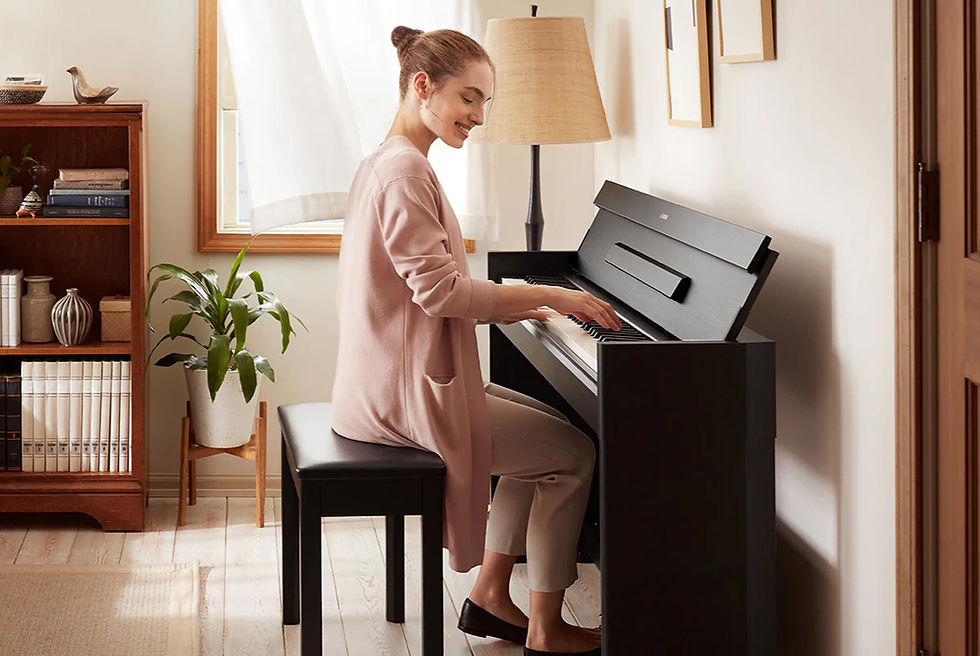
A digital piano solves practical challenges that are very real for busy families. Headphones let a student practice before school, after a sibling has gone to bed, or while a parent works nearby. Volume control is not just a convenience in a townhouse, apartment, or shared home. It can be the difference between regular practice and avoiding the instrument altogether.
Digital pianos also need far less space. Many models are slim enough for a bedroom, office, or multi-use family room, and some can be moved more easily than an acoustic piano. There is no tuning schedule, which makes budgeting simpler during the first years of lessons.
Practice features can be genuinely helpful when used well. A built-in metronome encourages steady rhythm. Recording functions allow students to hear their own playing from the listener's perspective. Some instruments offer accompaniment patterns or connections to learning apps, making practice feel more interactive for children who need extra encouragement.
Still, not every digital piano feels the same. A low-cost keyboard with light, unweighted keys is different from a quality digital piano with fully weighted, touch-sensitive action. If a child is taking regular lessons, choosing a model with 88 weighted keys and a responsive pedal will support better technique. A piano teacher can help guide that decision, particularly when a student is moving beyond the beginner stage.
Consider the Student Before the Technology
For a brand-new student, consistency matters more than a long list of features. A digital piano can be an excellent starting instrument when it has proper weighted keys and is placed where the student can sit comfortably and practice often. It gives families a manageable, dependable way to begin a musical journey.
For a committed intermediate or advanced student, an acoustic piano often offers more nuance in the key action and tone. That does not mean a digital piano is automatically inadequate. It means the student’s goals should lead the conversation. A teenager preparing challenging classical repertoire may benefit greatly from regular access to an acoustic instrument. An active student balancing band, sports, homework, and a full household may make more progress with a quality digital piano they can practice quietly every day.
Adult players have their own priorities. Someone returning to piano after many years may want the warmth and presence of an acoustic player piano. Another adult hobbyist may want headphones, easy recording, and the ability to play late at night. Neither choice is less musical. The better instrument is the one that invites you to sit down and play.
Think Beyond the Purchase Price
The upfront cost is only one part of the decision. A player piano generally costs more to purchase, deliver, tune, and maintain. In return, it offers an acoustic instrument and an entertaining feature that can add enjoyment for the whole family. It may also hold value differently than a digital instrument, depending on its condition, brand, age, and care.
A digital piano may have a lower starting cost and fewer ongoing maintenance needs. However, electronic technology changes over time, and speaker systems, controls, and internal components may eventually need service. It is wise to buy from a knowledgeable local music store that can help you understand the warranty, available service, and realistic quality differences among models.
Space is part of the cost as well. An acoustic player piano needs a stable, climate-conscious location where it can remain for years. A digital piano can be a smart choice when your home needs one room to serve several purposes. Measuring the intended spot before shopping prevents an exciting purchase from becoming an awkward fit.
Let the Home and the Music Decide
Before choosing, picture an ordinary Tuesday rather than a special occasion. Will your child be able to practice when the house is busy? Do you hope the piano becomes a centerpiece for family music and listening? Is this the first step in lessons, or an instrument for a serious player who is ready for more expressive control?
At Naperville Music, families can consider these questions alongside the instrument itself. Playing several options in person helps reveal details that specifications cannot: whether the keys feel comfortable, whether the sound suits your ears, and whether the instrument feels inviting enough to become part of a weekly routine.
The right piano is not necessarily the largest, most expensive, or most feature-packed one. It is the instrument that fits your space, supports your musician, and gives your family another reason to make time for music.
Only You Can Decide
Ultimately, only you can determine what is the “best value” for your family because it is the one that you find feels the most musical and satisfying to play and best fits your budget. Trying models from different manufacturers will help you determine how you respond to the core material emphasis, tonal balance, the engineered action as well as the touch profile of different instruments. That comparison is the best way to find your ideal piano.
Many value conscious buyers looking for the biggest bang for their dollar often also consider a pre-owned piano as it may offer a superior value choice over buying a new piano. A pre-owned model from a respected brand may offer the same professional structural features at a significantly lower price. Check out our posts on why a quality pre-owned piano may be a good value for your family, and also, what to watch out for when buying a piano from a private party.
Finally, many players often consider a digital piano. Check out our post on the differences between an acoustic and a digital piano and be sure to check out our digital pianos on our website and in our showroom.
Explore our new and pre-owned pianos at:
About Naperville Music
Naperville Music has been a trusted piano dealer in the Chicago area for over 50 years. Naperville Music offers new acoustic pianos from Pearl River Pianos, and Ritmuller Pianos. We also offer Digital Pianos from Yamaha, Roland and Pearl River, as well as pre-owned instruments from most major manufacturers including Yamaha, Kawai, Baldwin, Roland, Casio and others.
We are a family-owned business located conveniently to Naperville, and the Chicago Suburbs, be sure to check out our modern piano showroom before you make your piano purchase.
For more piano information, including helpful videos and detailed product descriptions, visit https://www.napervillemusic.com/pianos-and-keyboards
Naperville Music's qualified and friendly staff are available to discuss your piano needs with no obligation, via email, live chat, phone, or in person.
Naperville Music
1-630-355-1404 x106 (Ask for Nate)
Use Our Live Text To Chat

Text 1-630-354-0625 to chat online with Nate for more details
The information and views expressed in our blog posts are gathered from various sources and are consistent with the views of Naperville Music. Pianos, whether new, used, or digital are a very personal purchase and you should experience any piano to be sure it meets your specific needs before you purchase one.


Comments