


Yamaha Digital Piano Review for Every Player
Updated: Jul 26

A Yamaha digital piano review should answer a practical question before it talks about features: will this instrument make someone want to sit down and play again tomorrow? For a child beginning lessons, an adult returning to music, or a student preparing for school performances, that daily experience matters more than a long list of buttons.
Yamaha has earned a strong reputation because its digital pianos usually get the essentials right: a piano-focused sound, responsive keys, dependable construction, and models at several price points. The best choice is not automatically the most expensive one. It is the piano that fits the player's current skills, the home's space, and the family's plan for musical growth.
What Yamaha Does Well
Yamaha builds acoustic pianos as well as digital instruments, and that piano background shows in its approach. Even entry-level models are designed to feel like a musical instrument first, rather than a keyboard loaded with novelty sounds. Most players will spend their time using the main piano voice, practicing dynamics, and developing coordination with two hands. Yamaha generally makes that experience straightforward.
The company also offers a clear progression. Portable models can be a sensible beginning for a student who needs an instrument in a bedroom or shared family space. Furniture-style models add a more traditional look and often provide stronger speakers and a fuller pedal setup. Higher-end instruments offer more detailed key action and sound modeling for experienced pianists who want a closer acoustic-piano experience without the tuning and climate concerns of an acoustic instrument.
Reliability is another reason families often consider Yamaha. A digital piano is still an electronic product, so careful setup and reasonable care matter. But Yamaha models have a longstanding reputation for being dependable instruments for regular practice, lessons, and home use.
Yamaha Digital Piano Review: The Features That Matter
It is easy to get distracted by sound libraries, recording options, apps, and lesson functions. Those extras can be useful, especially for independent learners, but four fundamentals should lead the decision: key action, sound, speakers, and pedals.
Key action is the first priority
A beginner learning on unweighted or lightly weighted keys may enjoy making music at first, but the transition to an acoustic piano can be difficult. For most piano students, 88 weighted keys are the better long-term foundation. They help build finger strength, control, and the ability to shape soft and loud passages.
Yamaha uses several action systems across its lineup. The Graded Hammer Standard action found on many accessible models gives lower notes a heavier feel and higher notes a lighter feel, similar to an acoustic piano. It is a solid starting point for beginners and intermediate students. More advanced Yamaha instruments may use upgraded wooden-key or more detailed actions that provide greater subtlety and a more substantial feel.
No specification replaces playing the piano in person. Two instruments may both have weighted keys, yet one may feel more comfortable to a particular player. A child with smaller hands, an adult who has not played in years, and an advanced student working on expressive repertoire may each prefer something different.
Piano sound should encourage careful listening
Yamaha digital pianos are known for clear, familiar piano tones. The sound is generally polished and versatile enough for classical pieces, pop songs, worship music, jazz standards, and everyday lesson material. On lower-priced models, the main piano sound is often very good, though the speaker system may not reproduce the depth and resonance of a larger cabinet instrument.
As you move upward in the Yamaha range, you typically gain more detailed samples or modeling, longer sustain, richer resonance effects, and stronger amplification. These refinements matter most to advancing players who can hear and use the differences. A young beginner does not need every premium feature to develop good habits, but a serious student may eventually appreciate an instrument that responds more naturally to changes in touch and pedaling.
Headphones are worth considering, particularly in busy homes. Most Yamaha digital pianos allow quiet practice with headphones, which can make it easier to establish a consistent routine without competing with homework, television, or family schedules.
Speakers and cabinet design change the home experience
Portable Yamaha pianos are convenient. They can fit on a stand, move between rooms, and travel to a performance or rehearsal when needed. They are often an excellent value, especially when paired with a stable stand, bench, and proper sustain pedal.
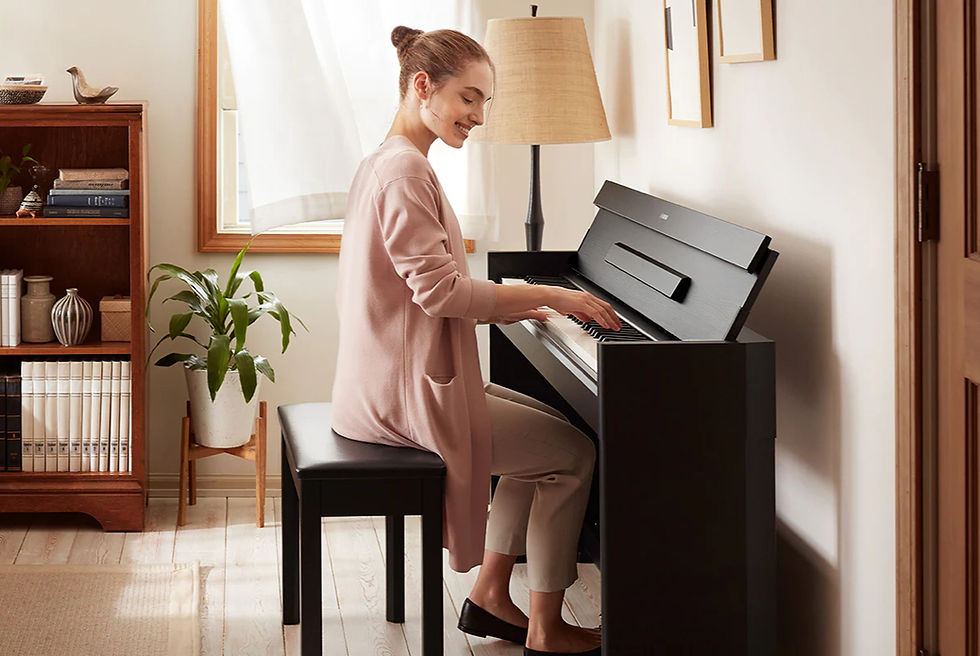
The trade-off is that portable instruments usually have smaller speakers and a less furniture-like presence. If the piano will remain in one location and be used by several family members, an Arius-style cabinet piano can feel more permanent and inviting. Its built-in stand, three-pedal unit, and larger enclosure create an experience closer to sitting at a traditional piano.
For some households, appearance is not a minor consideration. An instrument placed in a visible room is more likely to become part of family life. When a piano is ready to play, with a bench in place and music nearby, practice can feel like a normal part of the day rather than another item to set up.
Pedals matter more as students progress
A basic sustain pedal is enough for the first stage of many lesson books. As repertoire becomes more demanding, players benefit from a stable three-pedal unit and the ability to use more nuanced pedal techniques. Cabinet models commonly include this setup, while portable pianos may require an optional pedal unit and compatible stand.
Parents do not need to buy ahead for every possible future need. Still, if a student is already committed to lessons and practicing consistently, choosing a model with a full pedal setup can prevent an early upgrade.
A Practical Look at Yamaha Piano Families
Yamaha's product families make more sense when viewed by use rather than by model number.
The P series is often the logical starting point for families who need portability, a lower entry price, and authentic weighted keys. These pianos work well for beginners, apartment living, and students who may need to bring an instrument to a school event or shared rehearsal. Plan for the full setup, not just the keyboard itself. A secure stand, adjustable bench, sustain pedal, and headphones make a meaningful difference.
The Arius series is suited to homes looking for a dedicated piano station. It is a strong choice for students taking regular lessons who want 88 weighted keys, three pedals, and a cabinet that stays assembled. Compared with a portable piano, it usually offers a more complete at-home playing experience and helps create a consistent practice space.
The Clavinova line is geared toward players who want a more refined acoustic-style experience. These instruments can offer upgraded actions, more powerful speaker systems, deeper sound detail, and cabinetry that feels closer to a traditional upright piano. They cost more, but the investment can make sense for advanced students, experienced adults, or families choosing one piano for many years of use.
Yamaha also makes hybrid and premium digital options for players with very specific expectations. These are not necessary for most first-time buyers. They are best explored by pianists who already know the level of touch, tone, and cabinet design they want.
Choosing the Right Yamaha for Your Home
Start with the player's actual routine. A child who is excited to begin lessons needs an instrument that supports correct technique and is available for regular practice. An 88-key weighted model is usually the right target. A beginner does not need a high-end instrument, but they do need something stable, comfortable, and pleasant enough to use every day.
Then consider space and sound. A portable piano makes sense where flexibility is essential. A cabinet piano makes sense where the instrument has a permanent place. If practice must happen early in the morning or after younger siblings are asleep, headphone capability may be as valuable as upgraded speakers.
Finally, be honest about the player's direction. It depends on whether piano is an exploratory activity or an established commitment. A family can begin with a quality portable Yamaha and upgrade later. On the other hand, a student who has already shown steady interest may benefit from the stronger action, pedals, and speakers of a cabinet model from the start.
At Naperville Music, families can compare the feel of different instruments with guidance from people who understand the connection between a first lesson, regular practice, and long-term musical confidence. The goal is not to pressure a player into features they will not use. It is to help them find a piano that supports where they are going.
A Yamaha digital piano can be a dependable beginning or a lasting centerpiece for a musical home. Choose one that invites the player to practice, gives them room to grow, and leaves enough space in the family routine for music to become a source of confidence, focus, and enjoyment.
Only You Can Decide
Ultimately, only you can determine what is the “best value” for your family because it is the one that you find feels the most musical and satisfying to play and best fits your budget. Trying models from different manufacturers will help you determine how you respond to the core material emphasis, tonal balance, the engineered action as well as the touch profile of different instruments. That comparison is the best way to find your ideal piano.
Many value conscious buyers looking for the biggest bang for their dollar often also consider a pre-owned piano as it may offer a superior value choice over buying a new piano. A Pre-Owned model from a respected brand may offer the same professional structural features at a significantly lower price. Check out our posts on why a quality pre-owned piano may be a good value for your family, and also, what to watch out for when buying a piano from a private party.
Finally, many players often consider a digital piano. Check out our post on the differences between an acoustic and a digital piano, and then be sure to check out our digital pianos on our website and in our showroom.
Explore our new and pre-owned pianos at:
About Naperville Music
Naperville Music has been a trusted piano dealer in the Chicago area for over 50 years.
Naperville Music offers new acoustic pianos from:
Yamaha Pianos, Pearl River Pianos, Ritmuller Pianos.
We also feature Digital Pianos from
Yamaha, Roland, Pearl River
You can also choose from pre-owned instruments from most major manufacturers including:
Yamaha, Kawai, Baldwin, Roland, Casio and others.
Naperville Music is a family-owned business located conveniently to Naperville, and the Chicago Suburbs. Be sure to check out our modern piano showroom before you make your piano purchase.
For more piano information, including helpful videos and detailed product descriptions, visit https://www.napervillemusic.com/pianos-and-keyboards
Naperville Music's qualified and friendly staff are available to discuss your piano needs with no obligation, via email, live chat, phone, or in person.
Naperville Music
1-630-355-1404 x106 (Ask for Nate)
Use Our Live Text To Chat

Text 1-630-354-0625 to chat online with Nate for more details
The information and views expressed in our blog posts are gathered from various sources, and are consistent with the views of Naperville Music. Pianos, whether new, used, or digital are a very personal purchase and you should experience any piano to be sure it meets your specific needs before you purchase one.

Comments