


Piano Regulation for a Better Playing Experience

A piano can be in tune and still feel frustrating to play. If a child is practicing for a school recital and certain keys respond slowly, feel unusually heavy, or produce less sound than others, piano regulation may be the missing piece. This detailed adjustment of the piano’s moving parts helps restore the consistent touch and response that players need to learn, practice, and perform with confidence.
For families, the difference is often easy to hear and feel. Practice becomes less of a struggle when the instrument responds predictably. For experienced players, a well-regulated piano offers greater control over tone, dynamics, and expression. It is not a cosmetic service or a replacement for tuning. It is the careful mechanical work that helps an acoustic piano do what it was built to do.
What Is Piano Regulation?
Inside an acoustic piano, every key operates a series of precisely timed wooden, felt, leather, and metal components. When a player presses a key, that action must move smoothly through the piano’s mechanism, send a hammer toward the strings, and return quickly enough to play the next note. The process happens in a fraction of a second, but it relies on many small adjustments being in balance.
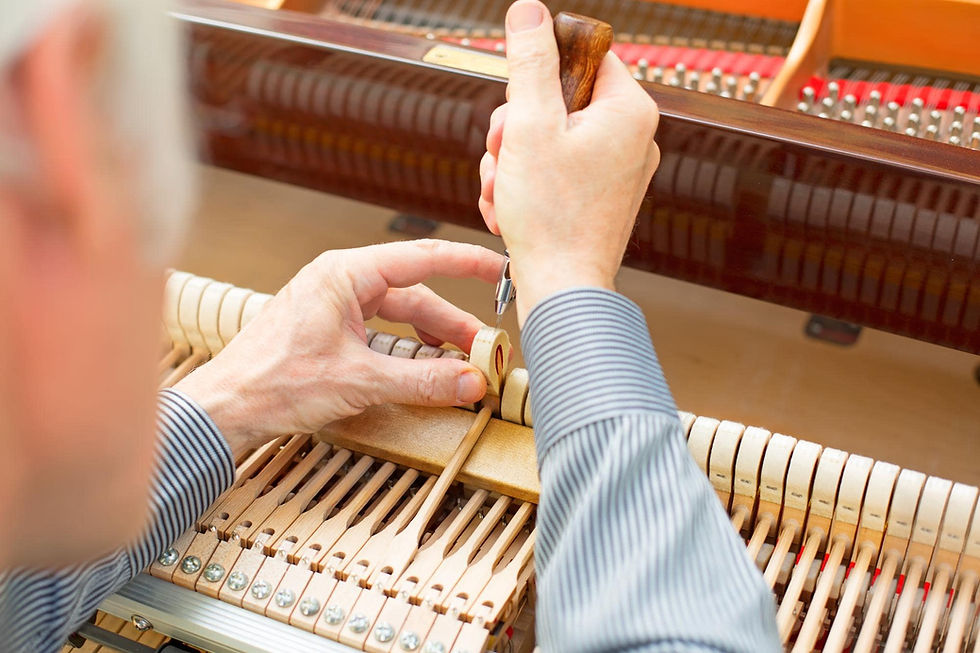
Piano regulation is the process of setting and aligning those adjustments. A piano technician may correct key height, key dip, hammer alignment, let-off, drop, repetition, damper timing, and pedal function. The goal is not simply to make the piano louder or softer. It is to make each key feel and respond as consistently as possible across the keyboard.
A piano has thousands of moving parts, and normal use gradually changes their relationship to one another. Felt compresses, wood reacts to seasonal humidity shifts, and parts wear with playing. Even a piano that is cared for and tuned regularly will eventually need regulation.
Piano Regulation and Tuning Are Different Services
Tuning adjusts the pitch of the strings. Regulation adjusts the action, or the mechanism that connects the keys to the hammers and dampers. Both are essential, but they solve different problems.
If your piano sounds sharp or flat, or intervals no longer sound pleasant together, it likely needs tuning. If it sounds reasonably in tune but feels uneven under the fingers, the action may need attention. A key that sticks, a note that fails to repeat quickly, or a pedal that does not release cleanly are all mechanical concerns.
Many pianos need tuning more frequently than regulation. In a typical home, tuning is often recommended about twice a year, particularly in Illinois where changing seasons can affect an instrument. Regulation is usually needed less often, though the right schedule depends on the piano’s age, condition, environment, and amount of use. A heavily played lesson piano may need attention sooner than a lightly used home instrument.
Signs Your Piano May Need Regulation
A player often notices regulation issues before they can name them. Children may say that a key feels “weird” or that they have to press harder to make a sound. Those observations matter. A developing musician needs an instrument that gives clear, reliable feedback.
Watch for these common signs:
Some keys feel heavier, lighter, deeper, or higher than neighboring keys.
Notes repeat slowly or fail to play when a key is pressed softly.
A key sticks, clicks, wobbles, or does not return properly.
Hammers strike inconsistently, causing uneven volume or tone.
Dampers leave notes ringing longer than they should, or stop them too abruptly.
Pedals squeak, feel loose, or do not work consistently.
One isolated problem may call for a small repair rather than full regulation. When several issues appear across the keyboard, however, a more complete service is often the sensible choice. A qualified technician can evaluate the piano and explain what work will make the greatest difference.
Why Even Touch Matters for Students
Beginning piano students are building coordination, finger strength, rhythm, and listening skills at the same time. An uneven instrument can get in the way of that progress. If one key takes more force than the next, a student may compensate with awkward hand position or inconsistent technique. If notes do not repeat reliably, fast passages become harder than they should be.
A responsive piano also helps students understand dynamics. Lessons often focus on playing softly, loudly, smoothly, or with a particular musical character. Those skills are difficult to practice if the instrument produces unpredictable results. Regulation gives the player a more dependable connection between what their hands do and what their ears hear.
This does not mean every family needs a concert-level action setup. The appropriate level of service depends on the piano and the player’s goals. Still, a home piano should be comfortable, safe, and dependable enough to support daily practice. That foundation can make lessons more enjoyable and help students stay motivated.
What Happens During a Regulation Appointment?
Before making adjustments, a technician assesses the instrument as a whole. They examine the action, keys, hammers, dampers, pedals, and the piano’s general condition. They may also look for concerns such as excessive wear, previous repairs, loose parts, or humidity-related changes.
The actual work is methodical. A technician may level the keys, set their proper travel distance, align hammers to the strings, and adjust the point at which each hammer releases on its way toward the strings. They check that notes repeat properly and that dampers lift and return at the right time. Pedals are tested and adjusted as needed.
Because each adjustment affects others, regulation is not a quick fix performed one key at a time without a plan. The technician works through the action in a careful sequence, then tests the results. A piano that has gone many years without service may need repairs, cleaning, or parts replacement before it can be fully regulated.
The work may also reveal an honest trade-off: some older or heavily worn pianos can be improved substantially, but not restored to the response of a newer, higher-quality instrument without more extensive rebuilding. A trustworthy service professional will explain what is realistic and help you decide where your investment will have the most value.
How to Help Your Piano Stay Regulated
Regular care reduces the effects of normal wear and changing conditions. Keep the piano away from direct sunlight, heating vents, exterior doors, and areas with dramatic temperature swings. Consistent indoor humidity is especially helpful, since the piano action and soundboard are made largely from wood.
Avoid placing drinks, plants, or heavy objects on the piano. Dust can be gently removed from the exterior with a soft cloth, but the inside of the instrument should be cleaned by a professional. Most importantly, keep up with regular tuning and have mechanical concerns checked before they become larger problems.
If your family has moved recently, inherited an older piano, or noticed that practice has become less comfortable, scheduling an evaluation is a practical next step. A piano does not have to be unplayable before it deserves attention.
Choosing Skilled Piano Service
Piano service requires specialized knowledge, patience, and an understanding of how musicians use an instrument. The best technician will listen to the concerns of the player, inspect the piano carefully, and describe the recommended work in plain language. They should be willing to distinguish between essential repairs, useful maintenance, and improvements that can wait.
At Naperville Music, piano owners can turn to a local team that understands the needs of beginning students, active musical families, and longtime players. Whether the piano supports a child’s first scales or years of advanced repertoire, dependable service helps protect the instrument and the progress made on it.
A well-regulated piano invites players back to the bench. When every key responds with a familiar, even touch, it is easier to focus on the music, enjoy the practice, and keep moving forward on a musical journey.
Only You Can Decide
Ultimately, only you can determine what is the “best value” for your family because it is the one that you find feels the most musical and satisfying to play and best fits your budget. Trying models from different manufacturers will help you determine how you respond to the core material emphasis, tonal balance, the engineered action as well as the touch profile of different instruments. That comparison is the best way to find your ideal piano.
Many value conscious buyers looking for the biggest bang for their dollar often also consider a pre-owned piano as it may offer a superior value choice over buying a new piano. A pre-owned model from a respected brand may offer the same professional structural features at a significantly lower price. Check out our posts on why a quality pre-owned piano may be a good value for your family, and also, what to watch out for when buying a piano from a private party.
Finally, many players often consider a digital piano. Check out our post on the differences between an acoustic and a digital piano and be sure to check out our digital pianos on our website and in our showroom.
Explore our new and pre-owned pianos at:
About Naperville Music
Naperville Music has been a trusted piano dealer in the Chicago area for over 50 years. Naperville Music offers new acoustic pianos from Pearl River Pianos, and Ritmuller Pianos. We also offer Digital Pianos from Yamaha, Roland and Pearl River, as well as pre-owned instruments from most major manufacturers including Yamaha, Kawai, Baldwin, Roland, Casio and others.
We are a family-owned business located conveniently to Naperville, and the Chicago Suburbs, be sure to check out our modern piano showroom before you make your piano purchase.
For more piano information, including helpful videos and detailed product descriptions, visit https://www.napervillemusic.com/pianos-and-keyboards
Naperville Music's qualified and friendly staff are available to discuss your piano needs with no obligation, via email, live chat, phone, or in person.
Naperville Music
1-630-355-1404 x106 (Ask for Nate)
Use Our Live Text To Chat

Text 1-630-354-0625 to chat online with Nate for more details
The information and views expressed in our blog posts are gathered from various sources and are consistent with the views of Naperville Music. Pianos, whether new, used, or digital are a very personal purchase and you should experience any piano to be sure it meets your specific needs before you purchase one.

Comments